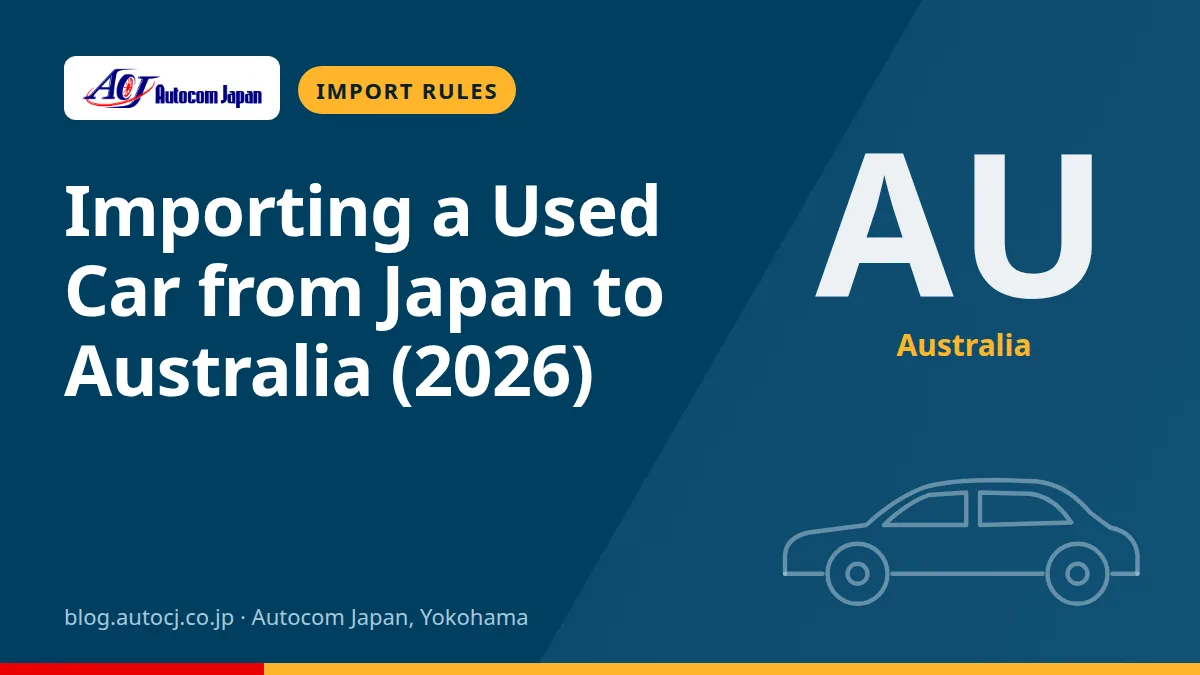
Yes, you can import a used car from Japan to Australia, but only if it fits an approved pathway, most often the 25-year rule for older vehicles or the Specialist and Enthusiast Vehicles Scheme (SEVS). You must hold an import approval, applied for in the government’s ROVER system, before the car is shipped.
Key takeaways
- Get your import approval in ROVER before the car leaves Japan. Importing a road vehicle without approval is an offence under the Road Vehicle Standards Act 2018 (RVSA).
- Cars built more than 25 years ago (counted from the build date) can use the “older vehicles” pathway. Newer Japanese models must be on the SEVS Register and modified by a Registered Automotive Workshop (RAW).
- The car must arrive clean (biosecurity) and free of asbestos. GST applies, and Luxury Car Tax applies above the ATO threshold. Border Force works out what you owe.
1. Check which pathway fits your car
Australia does not let you import any car you like. Under the RVSA, a used import needs a pathway that ends with the car on the Register of Approved Vehicles (RAV), which your state or territory needs before it will register the car.
The pathways that matter most for buyers in Japan are:
- Older vehicles (built more than 25 years ago). This concessional RAV entry pathway is for classic and collectible cars. The age is counted from the build date (month and year). If there is no month, the department assumes December of the build year. A car that was significantly modified in the last 25 years will not be added to the RAV.
- SEVS. Newer specialist or enthusiast models can come in only if that model is on the public SEVS Register. The car is then modified by a Registered Automotive Workshop (RAW) following an approved Model Report, and entered on the RAV.
- Personal effects. A separate pathway exists for migrants and returning Australian citizens who meet the conditions.
- Non-RAV entry approvals. These cover racing, exhibitions, film work and testing. They are not for normal road use.
If a newer car does not fit any pathway, you generally cannot bring it in for road use. Check the SEVS Register and the department’s pathway pages before you pay for anything. Our Australia import rules hub collects the related guides.
You can browse cars in Japan on our used car stock page. Autocom has no office in Australia, so you deal directly with our head office in Yokohama (sales@autocj.co.jp, +81-45-227-7095). Always ask us to confirm the exact build date before you apply for approval.
2. Apply for import approval in ROVER
The approval comes first. Everything else waits for it.
Create an account in ROVER, the Department of Infrastructure’s online portal, fill in the application and pay the application fee. The approval arrives by email and may come with conditions you must meet later. The department says an application may take up to 60 business days to be assessed, so apply before you commit to shipping.
Do not ship the car until you have the approval. Australian Border Force will not release a vehicle that arrives without one, and storage costs fall on the importer.
For the application you will need details that only the seller in Japan can give you: the chassis number, build date and the car’s condition. Ask for the auction sheet and photos, and read how the Japan export certificate records the car’s details.
3. Prepare for biosecurity and asbestos checks
Either of these checks can hold a car at the border.
Biosecurity. The car must arrive clean and free of soil, seeds, plant material, insects and animal material. The department’s import steps say to have the car steam cleaned inside and outside before shipping. Used vehicles get a full inspection on arrival unless they were treated by an offshore provider recognised by the Department of Agriculture, Fisheries and Forestry. You lodge a quarantine entry and book the inspection.
Asbestos. Importing asbestos into Australia is prohibited, and it is the importer’s job to make sure the car contains none before it is shipped. Border Force warns that asbestos can still be present even when the country of origin has banned it. Older cars carry the highest risk (brake, clutch and gasket parts), so arrange testing and removal before shipping if there is any doubt.
Whether you choose Ro-Ro or a container, don’t pack personal items inside the car. Our guide to Ro-Ro vs container shipping explains the difference.
4. Clear customs and pay GST, duty and Luxury Car Tax
Once the car is on its way, an import declaration is lodged with Border Force, usually by a licensed customs broker. You don’t calculate the charges yourself: Border Force sends an Outstanding Payment Advice.
- Customs duty. The Japan–Australia Economic Partnership Agreement (JAEPA) gives qualifying Japanese-built passenger and goods vehicles preferential customs treatment (check the current position with the Australian Border Force). Ask Border Force or your broker to confirm how it applies to your car.
- GST. Charged on almost every imported car.
- Luxury Car Tax (LCT). Applies when the car’s LCT value is above the threshold. The ATO sets a separate threshold for fuel-efficient vehicles and publishes new figures every year, so check them before you buy.
Keep these documents ready for your broker: the import approval, the bill of lading, the invoice and the export certificate. Our landed cost checklist lists everything that adds to the final price, with links to the official calculators.
5. Meet the approval conditions and register the car
After customs and biosecurity release the car, you finish the conditions attached to your approval.
For a SEVS car this means the RAW carries out the required work and the car is entered on the RAV. For an older vehicle, the approval itself leads to RAV entry. You can check any entry on the public RAV search in ROVER.
Finally, apply to your state or territory road authority for registration. Each state has its own inspection and paperwork, so check with them early, especially if the car is left-hand drive or heavily modified.
How to buy safely from Japan
Pay only into a bank account in Japan whose beneficiary is “Autocom Japan Inc.” The official list is on our bank accounts page. If an invoice or message asks you to pay anyone else, it is fraud. Read our guide on how to avoid scams when buying cars from Japan.
Wondering whether importing makes sense at all? See why Australian buyers choose Japanese used cars. If you are after a mainstream model that is widely sold in Australia, buying locally is usually simpler.
Frequently asked questions
Can I import a car from Japan that is less than 25 years old?
Only if it fits another pathway, usually SEVS. The exact model must be on the SEVS Register, and a Registered Automotive Workshop must modify it before it goes on the RAV.
How is the 25 years counted?
From the build date shown on the car (month and year). If the build month is missing, the department assumes December of that year. Ask us for the build date before you apply.
Do I pay customs duty on a Japanese car?
JAEPA gives qualifying Japanese-built passenger and goods vehicles preferential customs treatment (check the current position with the Australian Border Force), but GST still applies, and LCT applies above the threshold. Border Force tells you the final amount in its Outstanding Payment Advice.
Can I ship the car first and apply for approval later?
No. You need the import approval before the car is shipped. Border Force will not release a car that arrives without one.
Does Autocom have an office in Australia?
No. Australian buyers deal directly with our head office in Yokohama. Payments go only to Autocom Japan Inc. bank accounts in Japan.
Sources
- Department of Infrastructure: Importing a road vehicle into Australia (checked 1 Oct 2026)
- Department of Infrastructure: 8 steps to importing a vehicle (checked 1 Oct 2026)
- Department of Infrastructure: Concessional RAV entry approvals (checked 1 Oct 2026)
- Department of Infrastructure: How to import your older vehicle (25 years or older) (checked 1 Oct 2026)
- Department of Infrastructure: Specialist and enthusiast vehicles (checked 1 Oct 2026)
- ROVER: RAV public search (checked 1 Oct 2026)
- Australian Border Force: Importing a motor vehicle (updated 28 Sep 2026)
- Australian Border Force: Asbestos in imported motor vehicles (updated 28 Sep 2026)
- Department of Agriculture, Fisheries and Forestry: Importing vehicles and machinery (updated 10 Jul 2025)
- Australian Taxation Office: Luxury car tax rate and thresholds (checked 1 Oct 2026)
- DFAT: JAEPA outcomes at a glance (checked 1 Oct 2026)